The Doctor is Out of Office
Good morning. Today, we’re looking at the red metal that’s currently acting like it’s made of solid gold.
Copper has historically been the ultimate economic barometer, earning it the nickname “Dr. Copper.” But with prices hitting a record $14,000 per metric ton on the LME, the old rulebook has officially been thrown out the window.
Traditionally, copper demand moves in lockstep with global industrial manufacturing. However, this massive price spike is happening during a period of tepid global growth, showing that structural scarcity has taken over.
- LME Spot Price: Breached $14,000 per metric ton.
- COMEX Futures: Climbed to ~$6.90 per pound.
- Global Industrial Production: Gained a modest 0.5% in early 2026.
The Upstream Mine Squeeze
We are facing a massive structural shortfall at the mining level. Finding new copper is getting harder, and building the mines to extract it is costing a fortune.
Average ore grades have plunged 40% since 1991, meaning miners have to dig up far more dirt to get the same amount of metal. It now takes an average of 17 years to bring a new mine from discovery to commercial production.
Let’s look at the current geopolitical breakdown of where copper is mined. The geographic concentration is incredibly high.
- Chile (~23% share): Struggling with aging infrastructure and declining ore grades.
- DR Congo (~14% share): Growing fast, but facing strict government export bans on raw concentrates.
- Peru (~11% share): Highly vulnerable to social protests and transport blockades.
Geopolitics and The Big Inventory Shuffle
Here is where things get truly wild. Check out how the global inventory dynamics have completely shifted:
U.S. stockpiles have reached a historic 1 million metric tons as traders rush to beat anticipated 50% import tariffs. This massive front-running has completely drained European and Asian warehouses, sending the market into a frenzy.
According to a report on CNBC, this price action is sending a powerful message about the state of global infrastructure. We are no longer dealing with a cyclical commodity, but a strategic asset being hoarded like gold.
The Three Horsemen of Copper Demand
So, who is eating all the copper? It turns out the transition to a high-tech, green economy is incredibly metal-intensive.
First, we have the unstoppable push toward electric vehicles, which require massive amounts of wiring. Second, the renewable energy grid is hungry for heavy transmission lines to connect far-flung wind and solar farms.
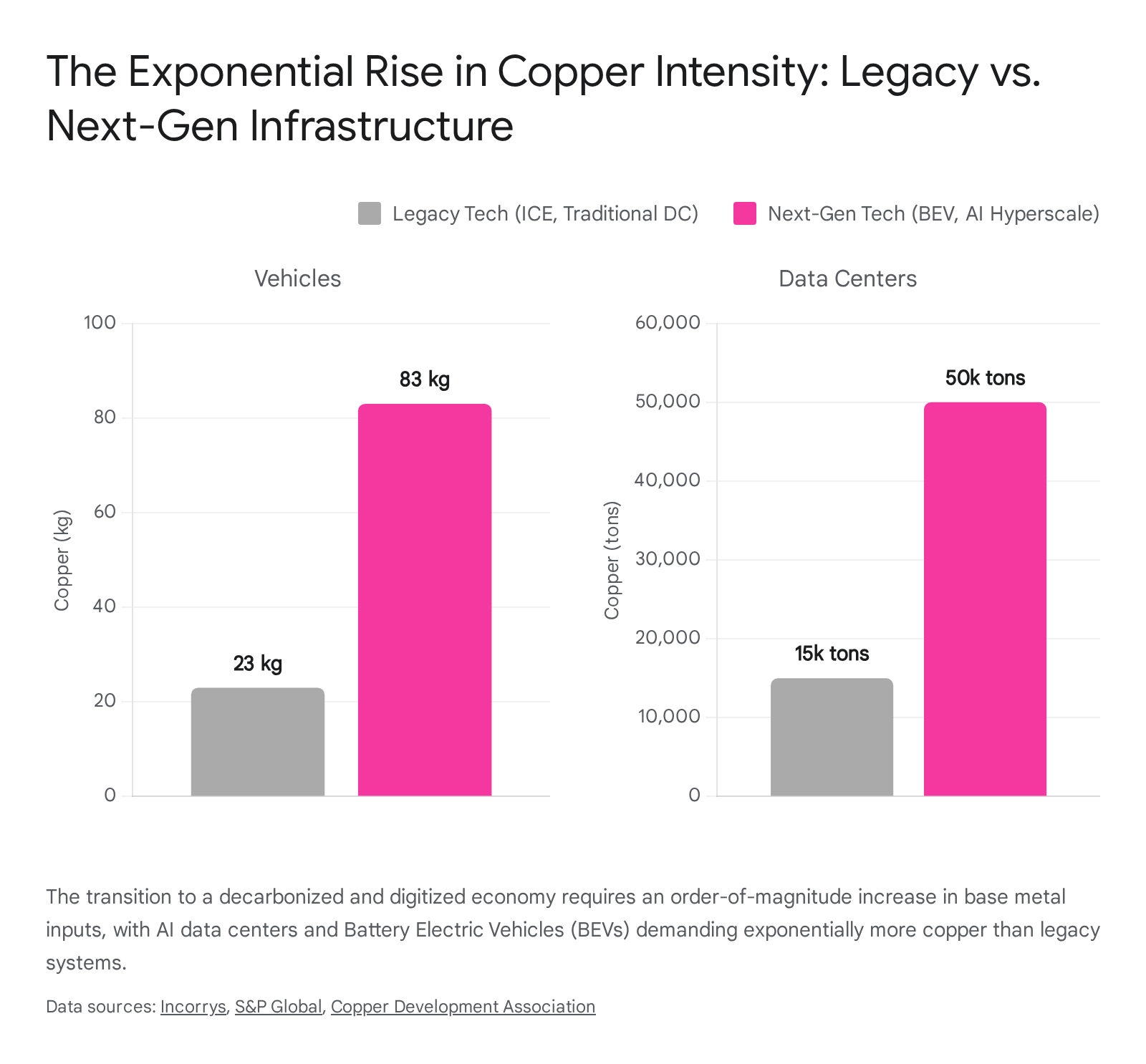
- EV Intensity: A fully electric vehicle requires 83 kg of copper, compared to just 23 kg for a gas car.
- Offshore Wind: Requires up to 15 tonnes of copper per megawatt of capacity.
- AI Data Centers: A single hyperscale AI facility can consume up to 50,000 tons of copper.
AI is the Ultimate Copper Hog
You can’t run advanced artificial intelligence algorithms without physical infrastructure. Modern AI data centers are packed with power-hungry GPUs that require massive amounts of copper for power delivery and specialized cooling.
Furthermore, active copper cables have become the goldilocks choice for high-speed networking between server racks. This brand-new demand vector is expected to add hundreds of thousands of tons of annual demand by 2030.