Vertical video is eating Hollywood. China’s hyper-fast micro-dramas are taking over smartphone screens across the globe. Powered by generative AI, the global micro-drama market has exploded into a $16.5 billion powerhouse.
These one-to-three-minute vertical episodes present a massive shift in digital entertainment. In early 2026, creators launched over 128,000 new vertical series. Generative AI created an astonishing 95% of them. Production costs plunged by 80% to 90%, dropping series budgets from $210,000 down to under $42,000.
How AI Alters the Micro-Drama Market
Cheap video tools cut creation time from three months to three days. In March 2026, Douyin added 50,000 AI series in a single month. That volume equaled the entire market output of 2025.
Live-action filming crews faced immediate displacement across major hubs like Zhengzhou. Studios laid off over 60% of staff while servers replaced physical costume departments. However, saving money on production created a surprising plot twist.
- Daily Ad Spend: Ad spending for AI shorts on Douyin surpassed $9.8 million daily.
- User Acquisition Costs: Performance ad networks now swallow 50% to 80% of total revenue.
- Platform Slashes: Platforms cut creator revenue payouts down to just 5% of earnings.
source: Wolfow
Platform Titans and User Arbitrage
Global app downloads hit 850 million in Q1 2026, rising 140% year-over-year. Viewers average 35.7 daily minutes on ReelShort, easily outpacing Netflix’s 24.8 minutes.
Global in-app purchase revenue reached $2.98 billion in 2025 across 331 active apps. Yet, monetization strategies differ sharply between market leaders:
- ReelShort: Relies on coin-based paywalls. Power users spend $50 to $80 monthly, but weekly churn tops 50%.
- DramaBox: Focuses on $49.99 annual subscriptions, retaining 15% of users after twelve months. It generated $10 million in net profits.
Much like how Bitcoin rally dynamics show shifting trader risk, media investors are reallocating capital into performance-driven models.
The Anti-AI Pushback
Infinite cheap content quickly creates consumer fatigue. Identical AI-generated faces triggered widespread user backlash on social media. Platforms like Tomato Novel began penalizing low-quality, repetitive uploads.
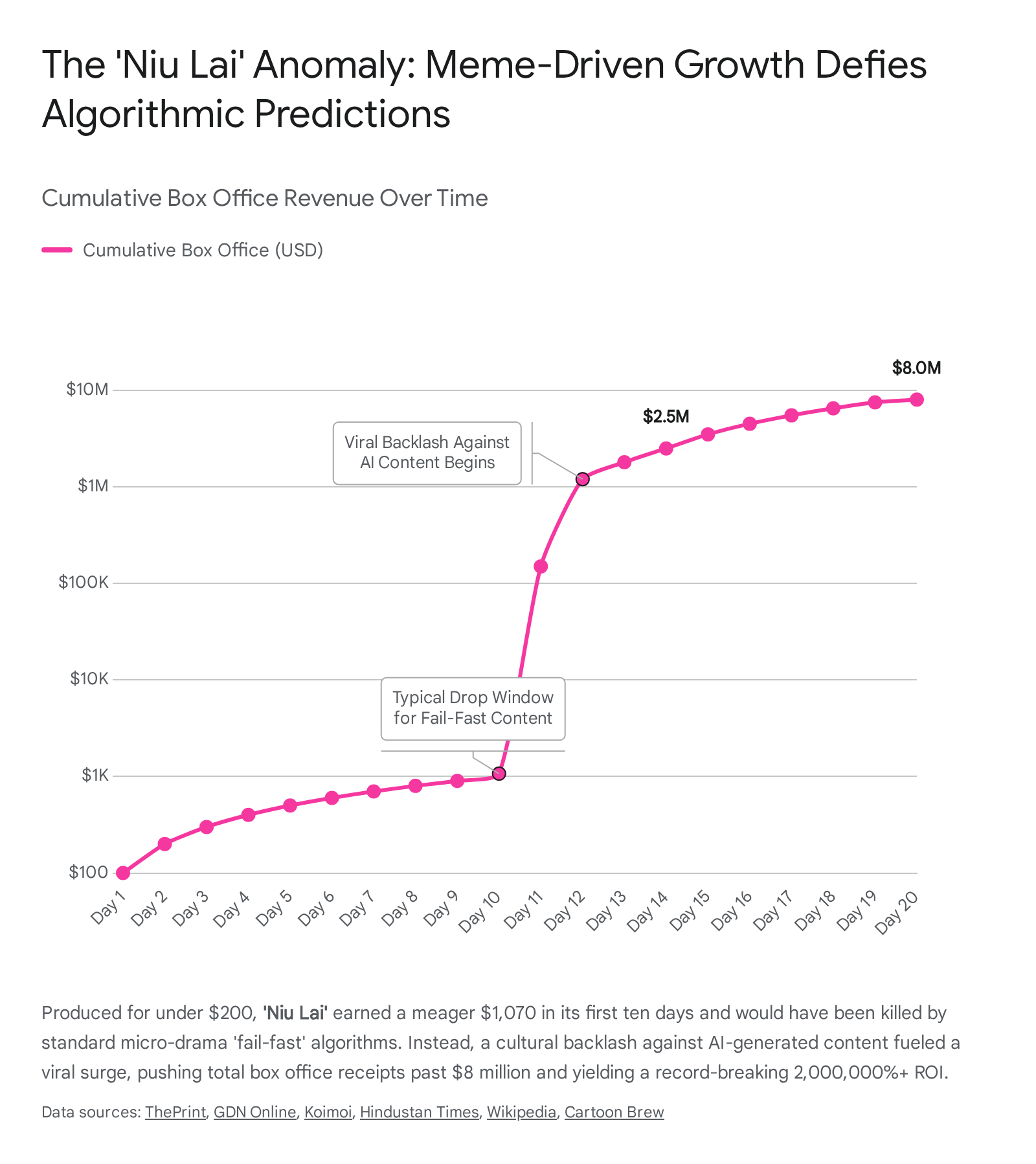
This fatigue fueled the surprise success of the handmade animated movie Niu Lai. A mother-son duo made the film for under $200 using crude software. The rough movie shocked industry observers by grossing over $8 million at the box office.
As detailed in recent reporting on entertainment economics, raw human storytelling still holds massive commercial value. Legacy media channels are taking notice. Companies like Disney and iQIYI are launching dedicated mini-drama incubators to catch up.
The Bottom Line for the Micro-Drama Market
AI stripped marginal production costs to near zero. This turned content creation into a aggressive user acquisition game. Winning in the evolving micro-drama market requires holding viewer retention and offering genuine, human-guided storytelling.