The Central Bank Battleground
A sharp Fed rate divide has officially opened up at the central bank. Released minutes from recent discount rate meetings show four regional Federal Reserve banks revolting against headquarters. While regional directors demanded a rate increase, the Board of Governors overruled them to keep policy steady.
- The Dissenters: Boards from Cleveland, Minneapolis, Dallas, and Kansas City voted to raise the discount rate from 3.75% to 4.00%.
- The Federal Reserve Pause: Chairman Kevin Warsh held the federal funds rate at 3.50% to 3.75%.
- Economic Stagflation: Headline PCE inflation accelerated to 3.70% year-over-year in July, while total nonfarm payrolls dropped by 23,000 jobs.
Unpacking the Fed Rate Divide and Economic Drag
This deepening Fed rate divide highlights a classic stagflation nightmare. Core PCE inflation reached 3.34% in July. Meanwhile, second-quarter real GDP growth slowed to just 1.48%. High energy prices and massive AI spending continue pushing costs higher across the supply chain.
source: Wolfow
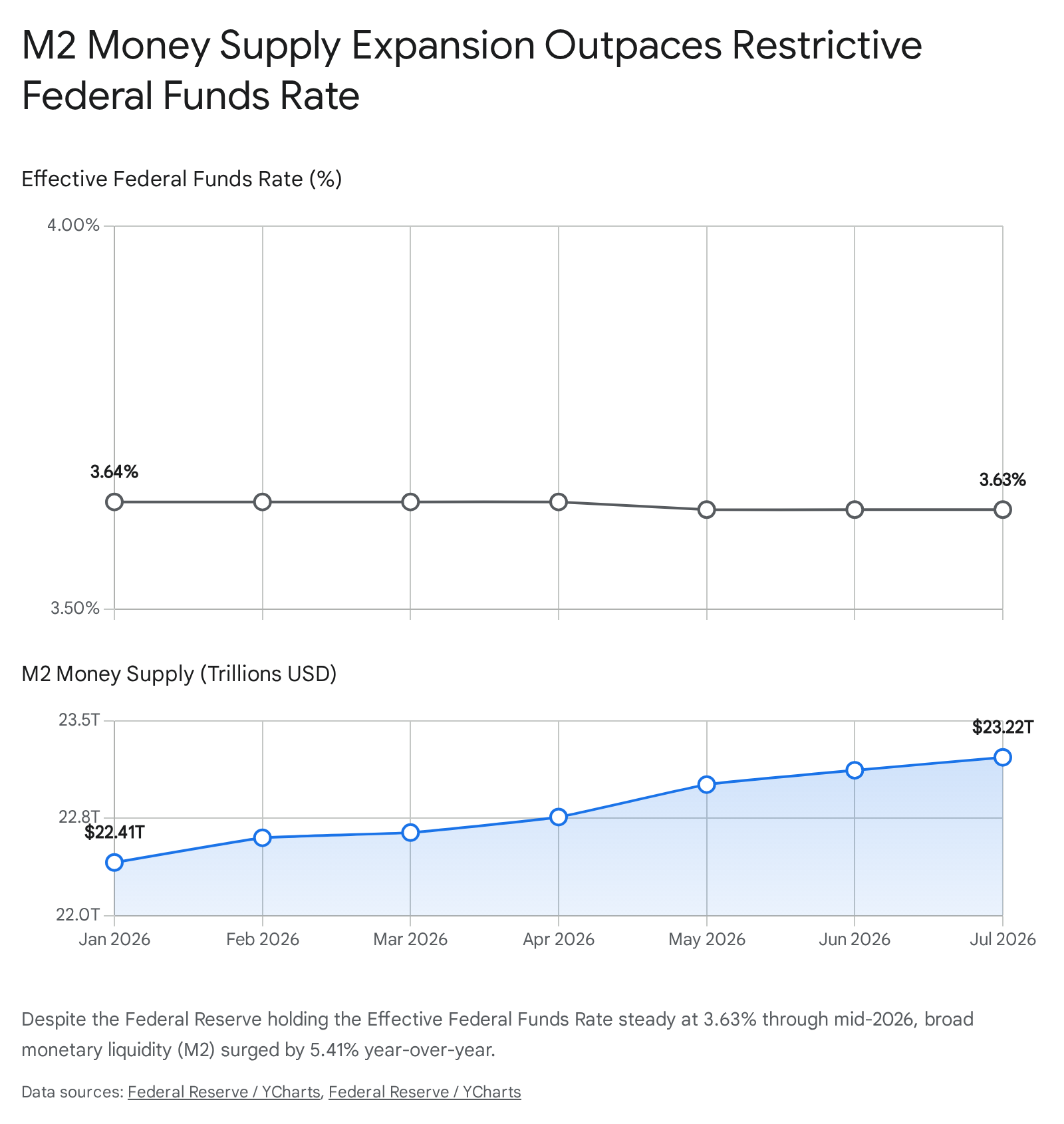
At the same time, monetary liquidity is expanding behind the scenes. The broad M2 money supply surged 5.41% year-over-year to $23.22 trillion in July. You can examine the official board disclosures through the official Federal Reserve release page.
Warsh Strategic Silence and Credit Pressure
Chairman Kevin Warsh has completely dismantled the central bank forward guidance framework. He refused to submit dot-plot economic forecasts, forcing financial markets to trade purely on incoming data without safety nets. This operational shift comes amid broader shifts in government oversight, including the current US banking regulation split across Federal agencies.
Sector Breakdown
- Corporate Retrenchment: Commercial and industrial loan balances fell slightly to $2,892.20 billion in July as companies cut spending.
- Consumer Debt Reliance: Total credit outstanding jumped $14.2 billion in June, powered by a 3.9% annualized surge in credit card debt.
- Housing Stalemate: Average 30-year fixed mortgage rates hovered near 6.78%, locking down national property transactions.
Treasury officials recently doubled bond buybacks to $4 billion per operation to cap long-term yields. As policymakers gather at Jackson Hole, the ongoing Fed rate divide promises heightened market volatility ahead.