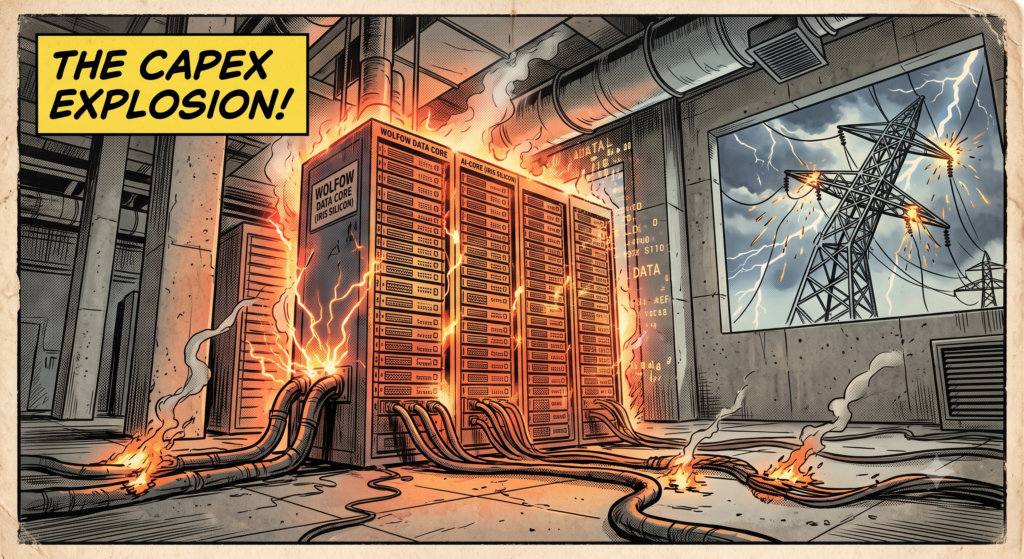
The software-driven golden era of “asset-light” tech is officially dead, replaced by massive concrete data centers and screaming graphics cards. If you want to build the future of intelligence, you have to pay the thermodynamic piper.
A recent warning from Moody’s Ratings highlights a staggering paradigm shift in global finance. The credit agency warns that the unprecedented scale of artificial intelligence infrastructure spending is threatening to erode the free cash flow of Big Tech giants.
The Capex Explosion
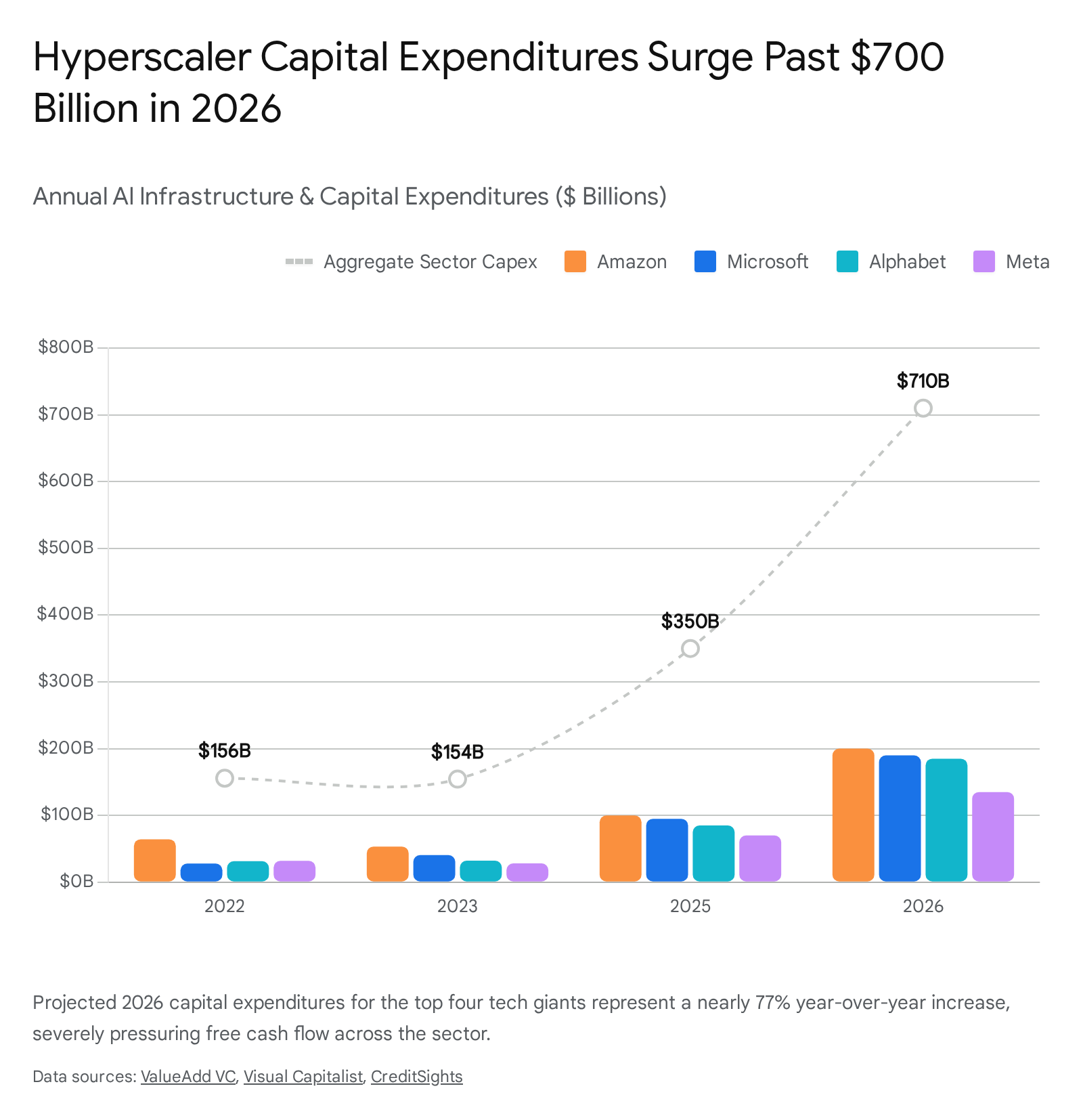
Collective capital expenditures across primary tech players are expected to hit $785 billion in 2026, marching toward $1 trillion by 2027. Big Tech’s legendary balance sheets are being aggressively cannibalized to lock down raw hardware capacity.
Let’s look at the eye-watering budgets driving this cycle:
- Amazon: Deploying $200 billion in 2026, leading to a temporary 95.4% collapse in trailing free cash flow.
- Microsoft: Committing $190 billion to capital expenditures to satisfy a massive $625 billion contracted backlog.
- Alphabet: Targeting up to $190 billion in spending, supported by an $85 billion equity sale.
- Meta: Accelerating its $135 billion midpoint budget to bring its custom “Iris” silicon to life.
source: Wolfow
But writing massive checks is actually the easy part of this infrastructure race. The real bottleneck is physics, specifically the sheer lack of electricity to power these gigawatt-scale hubs.
Thermodynamic Hard Stops
Modern AI server racks consume up to 100 kilowatts each, completely overwhelming regional utility capacities in North America and Europe. This order-of-magnitude increase has turned passive data centers into systemic threats to grid stability.
The electrical grid simply cannot keep pace with this hyper-growth. Consider these physical bottlenecks:
- Grid Lead Times: High-power transformers now face grueling wait times of up to 144 weeks.
- Power Costs: Wholesale electricity costs near major data hubs have skyrocketed by up to 267%.
- Stranded Hardware: Roughly 11 gigawatts of fully built data center capacity sits dark, waiting for grid hookups.
Shadow Leverage and Opaque Structures
To keep these massive liabilities off their pristine public books, tech giants are turning to sophisticated financial engineering. Moody’s reports that off-balance-sheet lease commitments have ballooned to an incredible $1.2 trillion.
This risk has migrated directly into private credit markets, creating a shadow banking hazard. Let’s look at how this financial feedback loop operates:
- Special Purpose Vehicles: Meta completed nearly $300 billion in financing for its Hyperion project using SPVs that hide 90% of the debt.
- Compute-for-Equity: Tech giants fund AI startups with billions of dollars, which those startups immediately spend back on the giants’ cloud services.
- Sub-Lessor Paradox: SpaceX’s SPCX S-1 revealed Anthropic is paying xAI $1.25 billion monthly to rent supercomputer access.
Separating Fortresses from the Fragile
While Microsoft and Alphabet have highly profitable search and enterprise monopolies to absorb these losses, others are walking a tightrope. Moody’s draws a sharp line between highly diversified cash cows and lower-rated, pure-play competitors.
The credit risks are heavily concentrated in players betting their balance sheets on single-counterparty success. Watch these vulnerable nodes carefully:
- Oracle: Sitting just two notches above junk status (Baa2) while carrying $93 billion in debt to fund OpenAI’s $300 billion “Stargate” project.
- CoreWeave: Operating with a speculative Ba3 rating, relying entirely on GPU-collateralized loans highly vulnerable to technology obsolescence.
The AI infrastructure supercycle is a high-stakes race against hardware depreciation. If commercial revenues fail to materialize before this equipment becomes obsolete, the shadow leverage could trigger cascading margin calls across the global financial system.