
The investment world is undergoing a tectonic shift, and your grandfather’s mutual fund is officially on life support. As of mid-2026, the US ETF market has swelled to a gargantuan $15.8 trillion as investors aggressively abandon legacy vehicles.
This isn’t just a simple change in investor preference; it is a full-blown structural revolution driven by tax efficiency and tech obsession. At the center of this capital migration sits the unstoppable gravity of the artificial intelligence megatrend.
AI ETFs: Conviction Beats Volatility
Despite a highly volatile second quarter for tech stocks, investors didn’t panic and run for the exits. According to a report on JPMorgan’s latest insights, this dramatic jump in AI ETFs shows that long-term conviction is completely overriding short-term market jitters.
To understand where the smart money is moving, we have to look at the top five thematic categories dominating the market. The lines between software, hardware, and physical infrastructure are entirely blurring.
- Artificial Intelligence: $67 billion AUM
- Infrastructure: $40 billion AUM
- Defense & Cybersecurity: $15 billion average AUM each
Deconstructing the $3 Trillion AI “Layer Cake”
Wall Street is no longer just buying speculative software apps that promise to write your emails. Investors are systematically targeting the physical backbone of AI, from memory chips to energy grids.
Morgan Stanley estimates a staggering $3 trillion will be spent on AI-related infrastructure by 2028. This physical buildout is triggering massive bottlenecks in power supply and high-bandwidth memory.
- DRAM ETF (Roundhill Memory): Swelled to $23 billion in assets within months of its launch.
- Power Demands: Data center power usage is projected to surge by 14% annually through 2030.
- Grid Modernization: The EU alone needs €584 billion in power grid upgrades to survive the AI boom.
The Death of the Mutual Fund
While AI captures the headlines, a silent assassination is happening in your portfolio wrapper. The traditional open-end mutual fund is bleeding out, while ETFs enjoy historic, record-breaking inflows.
In 2025 alone, US ETFs brought in $1.49 trillion while legacy mutual funds shed a catastrophic $692 billion. To survive, giant asset managers are rapidly converting their multi-billion-dollar mutual funds into ETFs.
The IRS Loophole: Why Fiduciaries Are Capitulating
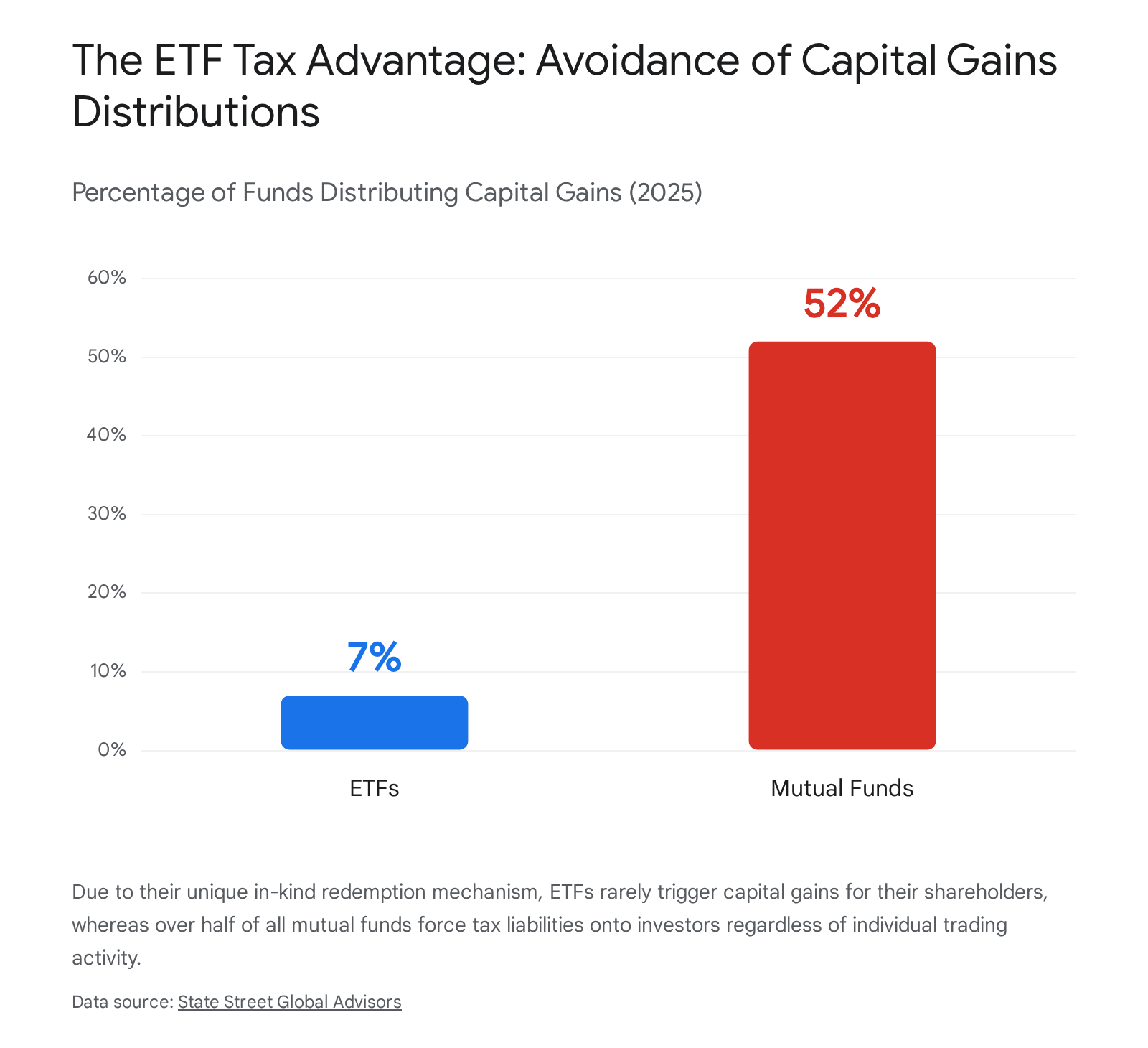
The exodus comes down to a structural tax loophole that favors ETFs over mutual funds. When mutual fund investors panic and redeem shares, the fund must sell assets, triggering a tax bill for everyone else.
ETFs bypass this entirely using “in-kind” creations and redemptions, essentially washing away capital gains taxes. State Street data shows 52% of mutual funds paid out capital gains taxes in 2025, compared to just 7% of ETFs.
Active Management Reborn
Don’t assume ETFs are just for passive indexing anymore. Actively managed ETFs accounted for a mind-boggling 85% of all new ETF launches over the past year.
Even though 79% of active managers still underperform the S&P 500, investors love the lower fees. By housing active strategies in the ETF wrapper, managers finally have a fighting chance to beat the market.