Nvidia is no longer just selling chips. It now acts as the central bank of artificial intelligence. By deploying a massive Nvidia balance sheet strategy, the tech titan directly underwrites global AI infrastructure. Second-quarter revenue surged 106% year-over-year to $96.2 billion. Yet Nvidia’s forward valuation multiple contracted by 44%. Check out our full Nvidia earnings outlook for deeper market context.
The Strengths and Risks of the Nvidia Balance Sheet
To keep buyers spending, Nvidia committed $300 billion toward equity investments and debt guarantees. Analysts project $469 billion in free cash flow across 2026 and 2027. This solidifies the Nvidia balance sheet as an operational powerhouse. Even a $500 billion stress scenario represents only 10% of enterprise value, according to recent Bank of America analysis.
source: Wolfow
However, credit markets remain deeply cautious about balance sheet exposure. Top hyperscalers face $1.3 trillion in capex with negative cash flow through 2027. To assist them, Nvidia partnered with Wall Street to launch a $500 billion compute financing syndicate. Critics warn this framework creates circular financing loops.
- Circular Deals: Nvidia invested $1.5 billion into SB Energy to backstop OpenAI’s Ohio data center campus.
- CDS Spreads: Nvidia’s 5-year credit default swap spreads reached 80.77 basis points over default worries.
- Equity Moat: A $63.4 billion stock portfolio includes $30 billion in Intel and $21 billion in SpaceX.
Software Integration and Custom Chip Threats
Nvidia is rapidly moving up the software stack to defend its moat. The firm agreed to acquire Hugging Face for $12.9 billion. It also signed a $6 billion licensing deal with Poolside to enhance its Nemotron models.
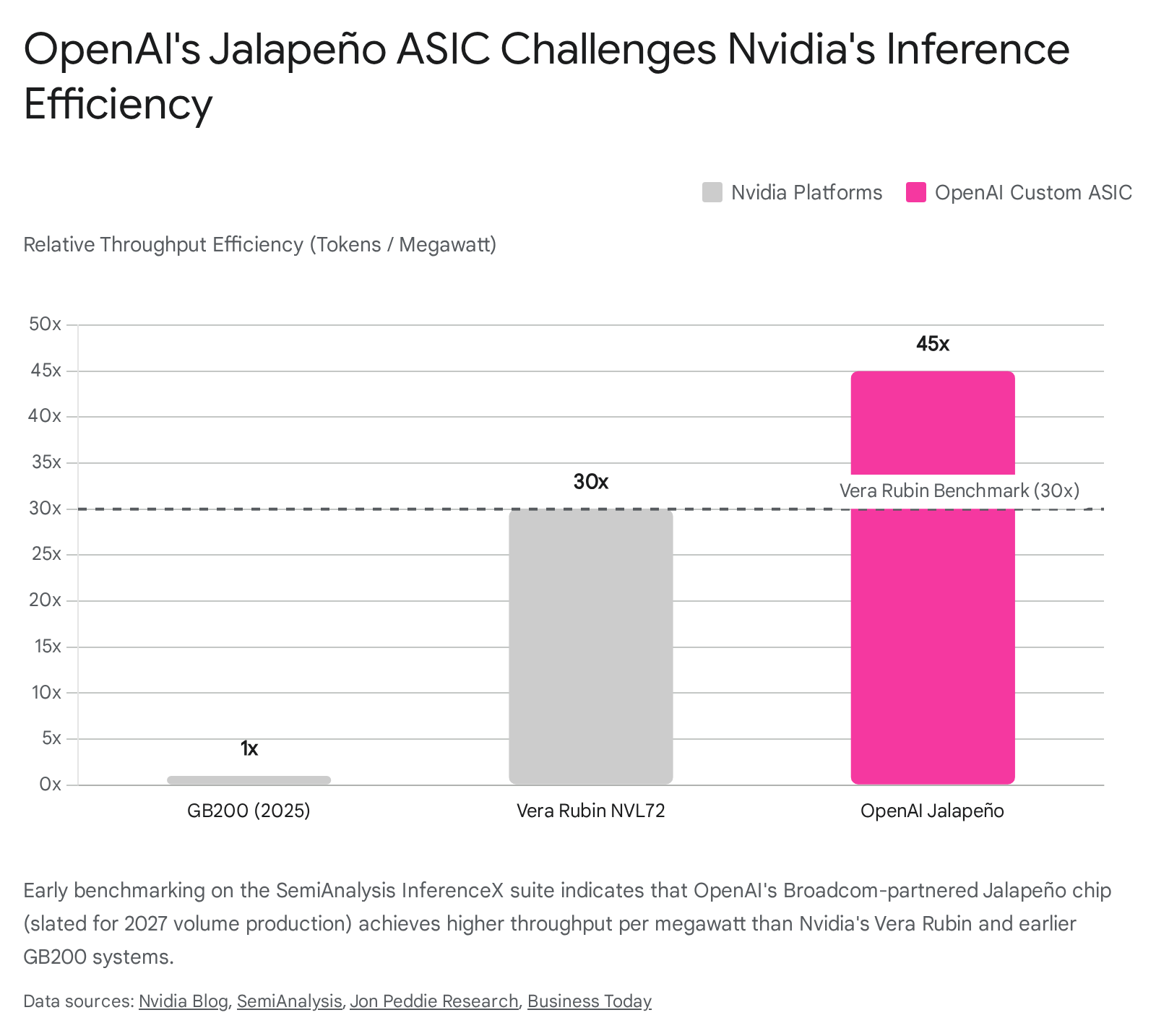
Silicon competition is also accelerating rapidly. Nvidia launched its Vera Rubin platform with 3.6 EFLOPS of inference compute. Meanwhile, OpenAI unveiled “Jalapeño,” a custom ASIC co-designed with Broadcom. Early benchmarks show Jalapeño processes 1.5 to 1.9 times more work per watt than existing standards.
Macro Forces and Market Catalysts
Federal Reserve Chair Kevin Warsh introduced a “Monetary Barbell” strategy. He targets lower policy rates alongside aggressive quantitative tightening. Lower rates encourage capital formation, while tighter liquidity forces tech firms toward private credit. Wall Street remains split on whether this Nvidia balance sheet expansion represents structural strength or hidden credit risk.
Beyond corporate balance sheets, peripheral developments are actively shaping the macro environment:
- Energy Supply: Iran established a tolled transit corridor in the Strait of Hormuz, threatening higher energy costs.
- Physical AI: Tesla prepares to launch its autonomous Cybercab robotaxi fleet in Austin, Texas.
- Platform Regulation: Meta settled state attorney general lawsuits for $17.1 billion, accepting minor usage limits.