
Good morning! The Federal Deposit Insurance Corporation and the OCC just overhauled bank oversight. Regulators are officially shifting their core focus to material financial risk. This joint final rule stops bank examiners from chasing minor administrative flaws. Instead, examiners will prioritize balance sheet health, solvency, and real liquidity threats.
Prioritizing Material Financial Risk in Supervision
The SVB collapse exposed major flaws in compliance-heavy supervision. Examiners previously issued endless notices for minor IT issues. Yet, they ignored real duration mismatches on balance sheets. Under the new rule, regulators clearly define unsafe practices. Enforcement actions now require actual quantifiable harm to bank capital, earnings, or liquidity.
Key changes include:
- Defined Standards: Enforcement targets real balance sheet threats instead of vague reputational concerns.
- Higher MRA Thresholds: Examiners log non-financial slip-ups as harmless Supervisory Observations.
- Lookback Limits: OCC caps historic AML audits at one year without high-level approval.
Basel III Rewritten: Capital Relief Arrives
Quantitative rules are relaxing alongside qualitative supervision. The March 2026 Basel III re-proposal scrapped the heavy 2023 mandates. Banks gain massive breathing room as capital requirements fall across the board.
The numbers tell a dramatic story:
- Mega Banks (GSIBs): Tier 1 capital demands drop by 4.8%.
- Regional Lenders: Tier 1 capital burdens drop by 5.2%.
- Community Banks: Requirements drop by 7.8%.
This relief unlocks $87.7 billion in system-wide capital. Banks can now expand lending or fund share buybacks. However, a US Banking Regulation Split has surfaced over GSIB surcharges. Short-term wholesale funding rules favor Wall Street giants over traditional deposit banks. Meanwhile, an updated report on US bank supervision highlights these shifting priorities.
Enforcement Drops While Penalties Surge
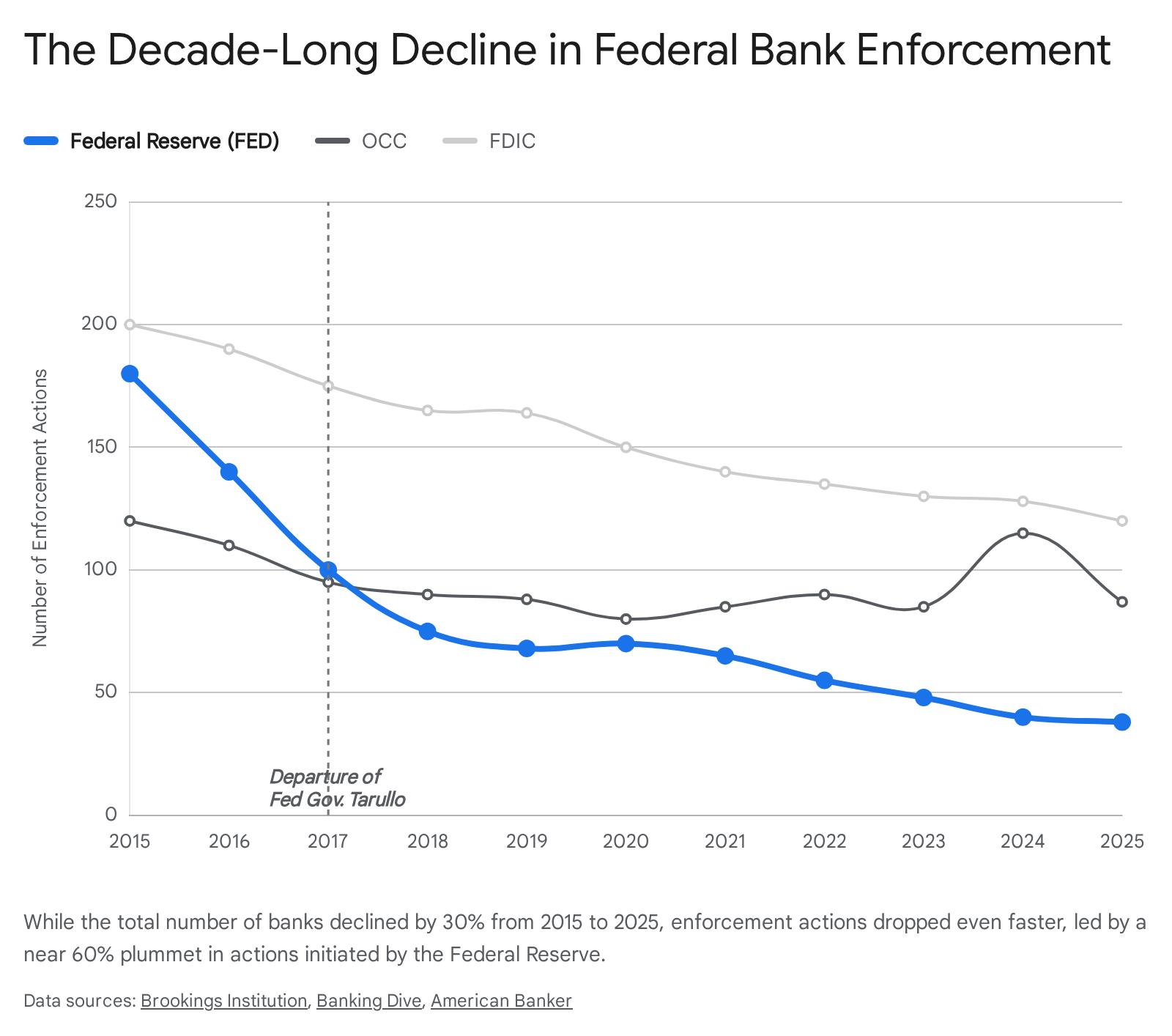
Public enforcement actions fell from over 500 in 2015 to 245 in 2025. Evaluating material financial risk allows regulators to ignore minor noise. But when big banks fail on anti-money laundering controls, penalties hit hard. TD Bank paid $1.2 billion in total fines for systemic failures.
source: Wolfow
The Digital Frontier and M&A Outlook
The industry is charging forward from a position of power. First-quarter bank net income hit $80.5 billion, up 14.3% year-over-year. Total assets grew to $26.1 trillion.
What to watch next:
- Bank M&A: Regional banks will merge faster to boost efficiency and cut costs.
- Stablecoin Guardrails: The GENIUS Act forces crypto issuers to meet bank-grade AML rules.
- Tech Upgrades: Freed compliance budgets are flowing into artificial intelligence tools.
By focusing on material financial risk, regulators are giving banks room to grow while enforcing core financial safety.